LIVE AUTOGRAPH AUCTION TV SPORT BATTLE OF BRITAIN, UK US LUFTWAFFE FIGHTER BOMBER ACES, DAMBUSTERS, NAVY, SPACE, CONCORDE
Lot 280:
Not sold
Description
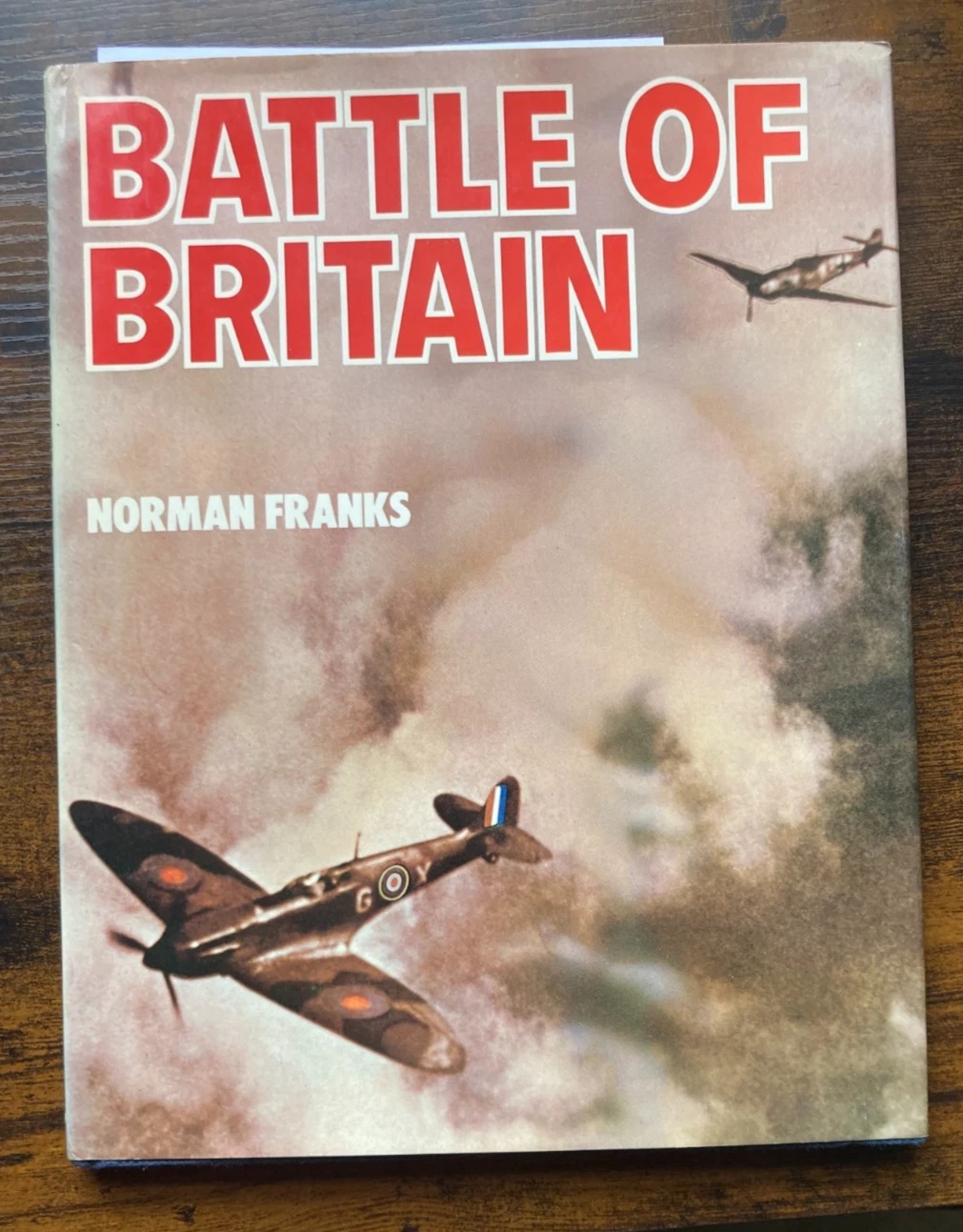
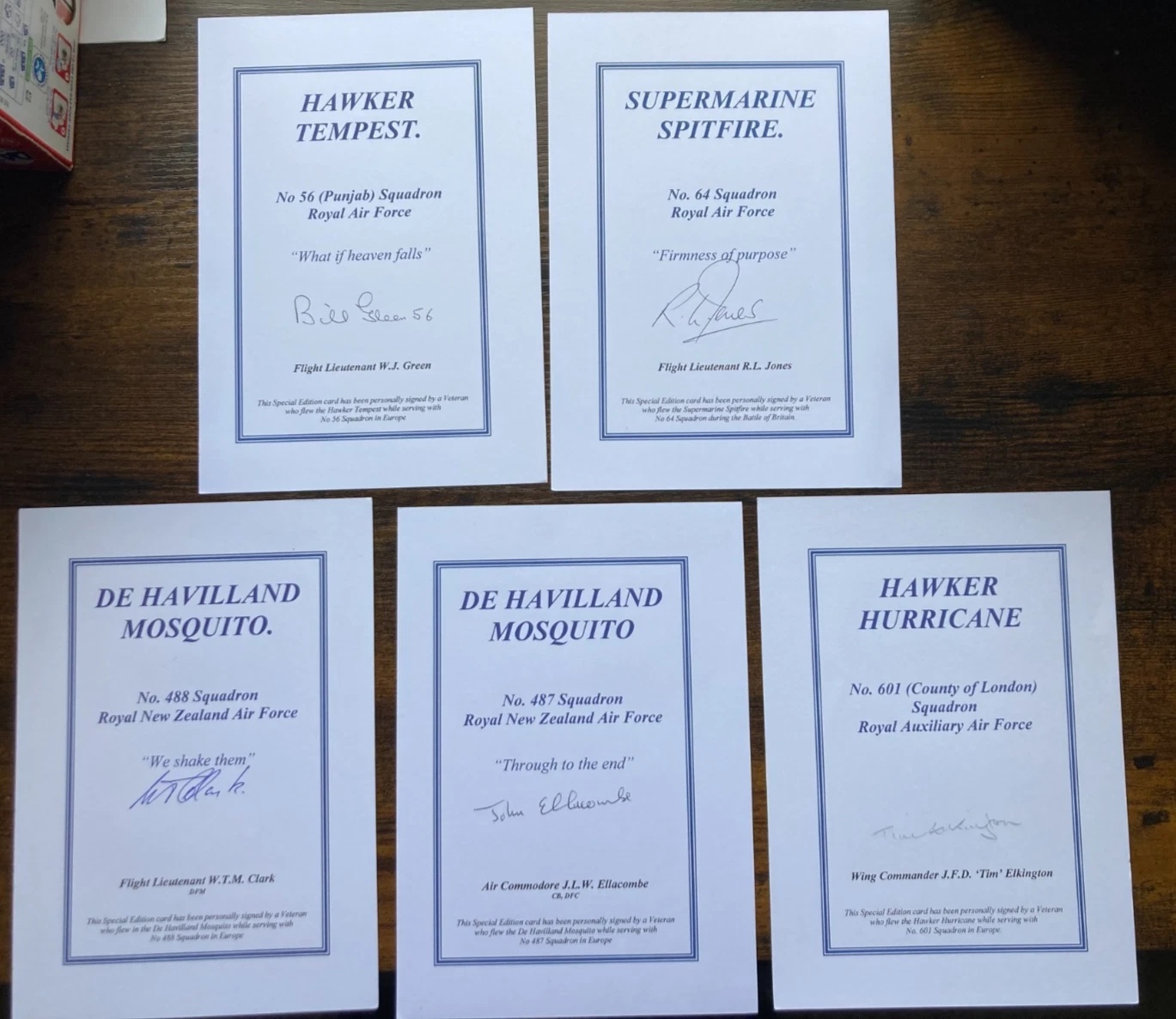
WW2 Five BOB pilots ace signed 1981 book Battle of Britain by Norman Franks. 5 limited edition loose bookplates signed by Flt Lt W Clarke DFM, Air Cdre John Ellacombe DFC, Wg Cdr J Tim Elkington, Flt Lt Richard Jones, Flt Lt W Bill Green. William Terence Montague Clark, DFM, AE (11 April 1919 – 7 May 2020) was a British nightfighter navigator/radar operator in the Royal Air Force (RAF) from 1938 to 1945. He, along with John Hemingway, was one of the last two verified surviving aircrew of the Battle of Britain. Clark enlisted in the Auxiliary Air Force in 1938 joining No. 615 Squadron at Kenley in March 1938 as an aircraft hand, then trained to be an aircraft gunner in Hawker Hectors on Army cooperation duties. He joined No. 219 Squadron, then flying Bristol Blenheims, at Catterick on 12 July 1940, later training on radar as a radio observer, flying in Bristol Beaufighters. On the night of 16/17 April 1941 Clark flew with the commanding officer of 219 Squadron, Wing Commander T.G. Pike, when Pike’s own navigator was taken ill. They intercepted and destroyed a Junkers Ju 88 and a Heinkel He 111 in the Guildford area. During the night of 27/28 April 1941, flying with Flying Officer D.O. Hobbis, his regular pilot, Clark assisted in the destruction of an unidentified enemy aircraft, on each of 1/2 June and 13/14 June 1941 they shot down a Heinkel He 111. Clark was awarded the Distinguished Flying Medal, which was gazetted on 8 July 1941. Commissioned as a Pilot Officer in May 1942, Clark had reached the rank of Flight Lieutenant by the end of the war. Post war Clark joined the reconstituted Royal Air Force Volunteer Reserve (RAFVR) in 1949 serving in the Fighter and Aircraft Control Branches before resigning his commission in 1954. Clark died on 7 May 2020 at the age of 101, leaving John Hemingway as the last surviving member of The Few. John Ellacombe joined the RAF in 1939 and was posted to 151 Squadron in July 1940, immediately converting to Hurricanes. On 24th August he shot down a He111, but a week later his Hurricane was blown up in combat and he baled out, with burns. Rejoining his squadron a few months later, in February 1941 was posted to 253 Squadron where he took part in the Dieppe operations. On 28th July, flying a Turbinlite Havoc, he probably destroyed a Do217. Converting to Mosquitos, John was posted to 487 Squadron RNZAF, and during the build up to the Normandy Invasion and after, was involved in many ground attacks on enemy held airfields, railways, and other targets of opportunity. He completed a total of 37 sorties on Mosquitos. Flying a de Havilland Mosquito XIII with a devastating set of four 20mm cannon in the nose, John Ellacombe flew deep into occupied France on the night before D-Day searching out and destroying German convoys and railway targets. As the Normandy campaign raged on, 151 Squadron intensified its interdiction sorties – including night attacks on Falaise and the Seine bridges. On August 1st Ellacombe took part in the famous attack by 23 Mosquitoes on the German bar-racks in Poitiers, led by Group Captain Wykeham Barnes. Ellacombe had first joined 151 Squadron during the Battle of Britain, direct from Flying Training School. Within weeks he had scored his first victory but also force landed in a field, having shot down a He 111, and baled out of a blazing Hurricane. He baled out a second time during the Dieppe Raid in 1942 but was picked up safely. Postwar he had a long and successful career in the RAE. Wing Commander John Francis Durham “Tim” Elkington (23 December 1920 – 1 February 2019) was a British Royal Air Force (RAF) fighter pilot who flew during the Battle of Britain, and was one of the last surviving aircrew known as “The Few”. Elkington joined the Royal Air Force in September 1939 as a Flight Cadet at the Royal Air Force College Cranwell. Between October 1939 and April 1940 he trained at No. 9 Elementary Flying Training School at RAF Ansty. Elkington then undertook further training with No. 17 Service Flight Training School at RAF Cranwell. He was commissioned on 14 July 1940[3] and joined No. 1 Squadron RAF at RAF Northolt a day later and flew Hawker Hurricanes during the Battle of Britain. His first confirmed “kill” came on 15 August 1940, downing a Messerschmitt Bf 109. A day later he was shot down and wounded on 16 August 1940 (research shows that he was shot down by Helmut Wick). After recuperating at the Royal West Sussex Hospital at Chichester he rejoined No. 1 Squadron on 1 October 1940 at RAF Wittering. After a spell with No. 55 Operational Training Unit as an instructor, in late May 1941 he joined No. 601 Squadron RAF at RAF Manston. He was promoted to Flying Officer on 14 July 1941. From there he joined No. 134 Squadron RAF at RAF Leconfield in July 1941. On 12 August 1941 the squadron embarked on HMS Argus and took off from the carrier on 7 September for an airfield near Murmansk. Until mid-October 1941 Elkington took part in escorting bombers and also trained Russian pilots to fly the Hurricane. On 6 October 1941 Elkington together with Sgt. B. Barnes from the No. 134 Squadron[citation needed] shot down a German bomber Junkers Ju 88 over Vayenga. He returned from Russia in January 1942. In April 1942 he joined the Merchant Ship Fighter Unit (MSFU) at RAF Speke until August 1942. After a short period with No. 1 Squadron again, in September 1942, Elkington joined No. 539 Squadron RAF at RAF Acklington flying Hurricanes alongside Douglas A-20 Havoc aircraft on night operations. He was promoted Flight Lieutenant 14 October 1942. After 539 Squadron was disbanded in late January 1943, he joined No. 197 Squadron RAF at RAF Drem flying the Hawker Typhoon. After operations from RAF Tangmere he was posted to No. 67 Squadron RAF at Alipore, Calcutta in December 1943. When the tour expired, Elkington spent three years commanding AFDU at RAF Amarda Road and he returned home in October 1946. Richard Jones was born in 1918 and in July 1940 he was posted to 64 Squadron at Kenley, flying Spitfires. He was involved in heavy fighting over the Channel during the Battle of Britain, with the squadron suffering many losses during July and August. Towards the end of the Battle of Britain, in October, he moved to 19 Squadron flying Spitfires from Fowlmere, and was heavily involved in the fighter sweeps taking place at that time. Near the end of the Battle of Britain, Pilot Officer Richard Jones was shot down during a dogfight over Kent with Me 109s. Jones crash landed his Spitfire in a field, colliding with a flock of sheep – he would go on to write in his log book ‘Crashed into a load of sheep. What a bloody mess!’ After the Battle of Britain, Richard Jones became a test pilot for De Havilland at Witney in Oxfordshire, and test flew thousands of Hawker Hurricanes and other types, including civil types. After the war Richard Jones joined the RAFVR and started a long career in the motor industry. Sadly Richard Jones passed away on 7th March 2012. In December 1936, Bill Green joined the Auxiliary Air Force as an aero engine fitter with 501 Squadron at Filton, near Bristol. Shortly before the start of the Second World War, he was given a rare chance for an engine fitter. In 1938 he joined a scheme to recruit NCO pilots, qualifying as a Flight Sergeant and re-joined 501 at Bristol in July 1940. Sgt Bill Green had completed just 10 hours of dual flying – with an instructor. In October, he was sent for further flying instruction and on October 30th he had his first solo flight in a Magister aircraft. After more training – and getting married on June 3rd – he flew a Hurricane for the first time on August 8th 1940, when the Battle of Britain had been raging for a month. He flew from Kenley throughout the Battle of Britain until November, surviving being shot down twice, before being posted to 504 Squadron. After a spell instructing on Spitfires and Tomahawks, he converted to Typhoons, and from November 1944 served with 56 Squadron on Tempests. He flew more than 50 missions in Tempest fighter aircraft with 56 Squadron. He was shot down over Germany on February 22nd 1945 and spent the last three months of the war as a prisoner of war. After the war, Green enjoyed a hugely successful business career, ending up as the managing director and chairman of Crown Paints, before retiring on his 60th birthday. Flight Lieutenant Bill Green, who has died aged 97, was twice shot down flying a Hurricane during the Battle of Britain; five years later he was taken prisoner after again being shot down, this time over Germany. Green had less than 200 hours’ flying time, and just seven hours in the Hurricane, when he joined No 501 Squadron and was pitched into the fighting at the height of the Battle of Britain in August 1940. On August 24, flying from Hawkinge in Kent, his squadron was scrambled to intercept a raid against the nearby airfield at Manston. Green closed in to attack an enemy dive-bomber when his aircraft was hit by the airfield’s anti-aircraft fire. His Hurricane was badly damaged and the engine stopped – but he managed to glide to Hawkinge, where he discovered half the undercarriage had been shot away. He crash-landed and scrambled from the wrecked aircraft. Five days later his squadron was orbiting over Deal at 20,000ft when a large force of Messerschmitt Bf 109 fighters attacked the formation. The windscreen of Green’s aircraft was shattered and the engine damaged. With no control, he was forced to bail out. His parachute failed to stream correctly and the main canopy became entangled around his legs. He fought to release it and fell thousands of feet before it finally opened fully. Within seconds he hit the ground. He had been wounded in the leg and his days in the Battle were over. The son of a regular soldier, William James Green was born in Bristol on April 23 1917 and attended St Gabriel School. He left at 14 to work in a cardboard box factory specialising in packages for shoes and small goods, there he met the girl who would become his wife. Green was an enterprising boy and he designed a new, larger box. Receiving no encouragement from his manager, he took it to Mardon, Son and Hall, where he was offered a job. The company encouraged workmen to join auxiliary military units, and Green joined No 501 Squadron of the Auxiliary Air Force, stationed at nearby Filton. He trained as an aero-engine fitter and two years later volunteered to be a pilot. He was mobilised at the beginning of the war and completed his training before returning to No 501. After recovering from his wounds, he was posted to No 504 Squadron, based at Filton. One night he was cycling home when German bombers attacked Bristol in force and the city suffered heavy damage. Over the next few days Green flew standing patrols over the city and on a number of occasions chased enemy bombers away. He spent three years as a flying instructor before, in late 1944, joining No 56 Squadron, flying the RAF’s most powerful piston-engine fighter, the Tempest. The squadron was based at Volkel in the Netherlands and he flew low-level strafing attacks against trains, motor transport and supply columns. On February 22 1945 he came under fire from two friendly fighters but evaded them, only to be shot down near Osnabruck by intense anti-aircraft fire. I should have zigged when I zagged he said later. Green bailed out and was captured. His prison camp near Nuremberg was soon evacuated and the PoWs marched south to Stalag 7A, a large camp at Moosburg near Munich. On April 29 the US Seventh Army liberated that camp, and within two weeks Green was back in England. He was released from the RAF in December and received the Air Efficiency Award. Green returned to the cardboard box industry, then, in 1960, joined Reed International, rising to be chairman. Green admired the work of the Salvation Army and achieved great contentment in religious activities. In June 2012, aged 95, he flew in a two-seat Spitfire from Goodwood airfield. Bill Green married, in 1940, Bertha Biggs; she died in 2008, and he is survived by their son and daughter. Flight Lieutenant Bill Green, born April 23 1917, died on November 7 2014. Good Condition Est.
Share this lot: