Autograph Auction WW2, Dambusters, Battle of Britain aces, Space, Sport, Historic, Concorde, SOE, TV FDCs Coin covers
Lot 243:
Not sold
Description
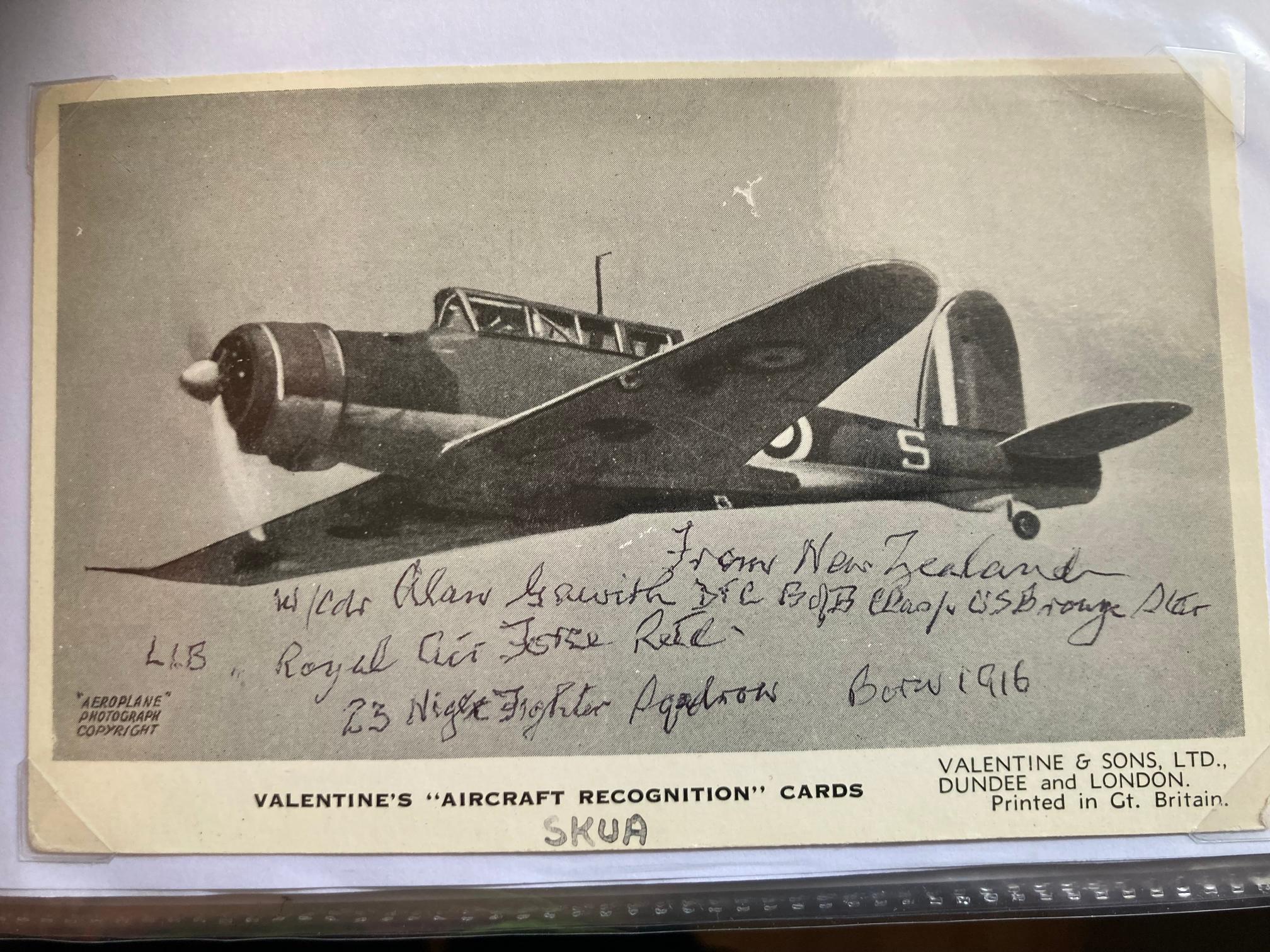
WW2 Battle of Britain Wg Cdr Alan Gawith DFC 43 Sqn Signed Skua vintage Valentine Postcard RARE inscribed with his details in WWII. Alan was born at Masterton in 1916 and by 1937 was studying at Victoria University of wellington. Alan recalled in a 2007 interview with Bee Dawson: One morning I saw in the Dominion an advertisement for Short Service Commissions in the RAF. I passed the paper to [my friend]. ‘Bloody good idea Alan’ he said – ‘Let’s go down and sign on…’ With only a small Air force in New Zealand at the time, NZ government policy was to support British schemes for dominion personnel to enter the RAF. Alan, along with 17 others, was selected; they sailed to the UK to undertake their flying training there. He flew ” Hawker Harts and Audax aircraft. And the Fury-a single seater. ” in March 1939 he was posted to 23 (Night Fighter) Squadron with Blenheims. “Being a night fighter, we were not really in the thick of the Battle of Britain. Our equipment was inadequate. We did get radar, started with it in May 1940, but nobody knew how to use it. I was flying for 14 months before I saw my first bomber-I fired a few shots but don’t think I disturbed it much! “We took over part of the day boys’ work like convoy patrols off the coast. We did the morning and evening patrols. We didn’t have any combats. We were always too late. We would see a few ships sinking and that sort of thing. “On 12 September [1940], the squadron was posted to Ford, in Sussex. We got bombed at Ford-we were only a mile or two from the south coast. The bombers would come in at dusk, just one or two, and drop a few bombs. You learned to ‘crawl under the carpet’. We were living in wooden shacks- the bullets would whip through the walls. We lost one or two aircraft bombed on the ground. And one of the bombs landed on an air raid shelter and killed a few. “After December 1940, we’d started intruder operations which meant that we went out over the Channel to patrol around the enemy bases. Having drifted around to somewhere close to Paris or up into Belgium, one had to find one’s way home. My policy was to use the White Cliffs of Dover because you could see them even on a very dark night. Alan was awarded the DFC (Distinguished Flying Cross), in May 1941 for attacking and destroying an important German communications centre. “By this time we were flying Bostons. I think they had the first tricycle undercarriage in the Air Force. [On one mission] all of a sudden a bunch of searchlights came up and coned just below me. Ack-ack guns started from all round. I thought I’d get out and headed straight for one of the searchlights, releasing my eight bombs and giving the searchlight crew a hurry up with my [machine] guns and getting away almost at ground level. But the bombs upset the communications system for the whole fighter wing and put it out of action for that night.” Alan flew 88 night sorties, without a break. “In July 1941 they took me off Intruder Ops and I got posted to command a training unit for Turbinlites. We had a Boston aircraft with a searchlight in the nose and a ton and a half of batteries in the bomb bay. After we’d taken off in the dark, two Hurricanes from 3 Squadron took off and formed up one on each side, just under our wing. No lights anywhere-flying on the exhaust flame I suppose. “The theory was that ground control would put us more or less in the right position behind the enemy, within 1000 yards and you’d send one Hurricane forward. When it got very nearly there you’d press the button to light up the enemy, and the Hurricane would shoot him down.” [in fact the Turbinlite system proved totally ineffective.] After a staff job in no.9 Group hQ, Alan was sent to staff college “a year’s work in three months” and in 1944 was promoted to Wing Commander and seconded to the Ninth Us Air Defense Command as the senior British liaison officer. He was directly involved in planning for the invasion of Europe, and moved with the HQ Group to the Normandy beachhead soon after D-Day. (in 1949 the Us Government awarded Alan the Us Bronze Star Medal in recognition of his services for the invasion.) Meanwhile he had lost his brother. “My brother Peter arrived in England about the end of ’41-was a Sergeant pilot, a great friend of ‘Scotty’ – Des Scott [author of Typhoon Pilot]. My brother was lost on an intruder operation near the German border. While he was listed as ‘missing’ there was always hope that he might be a PoW. The difficult thing was wanting to know how he was lost. We didn’t discover that till 40 years later. Alan ended the war as the station commander of an RAF base. When he returned to New Zealand in October 1945 he had been away for seven and a half years, and by then had a wife and two children. Good condition Est.
Share this lot: